
Clarity in Practice | Decisions in Action | Responsible AI
Clarity Before Automation
Decision support grounded in how work actually gets done.
Decision support grounded in how work actually gets done.
About
Smart OP Solutions designs decision and performance support systems for complex, high-value work, reducing cognitive load and streamlining workflows. Knowledge workers, professionals, technicians, team leaders, and decision makers can move forward confidently in their complex and ambiguous decisions and tasks.
Some work is too important to rely on memory, too infrequent to build routine, and too complex for easy decisions. When decisions and actions stay implicit, cognitive load rises and effort is wasted.
Using knowledge engineering and expert systems, we help make the critical decisions and actions in that work explicit, so focus improves, unnecessary thinking drops, and performance holds when it matters most.
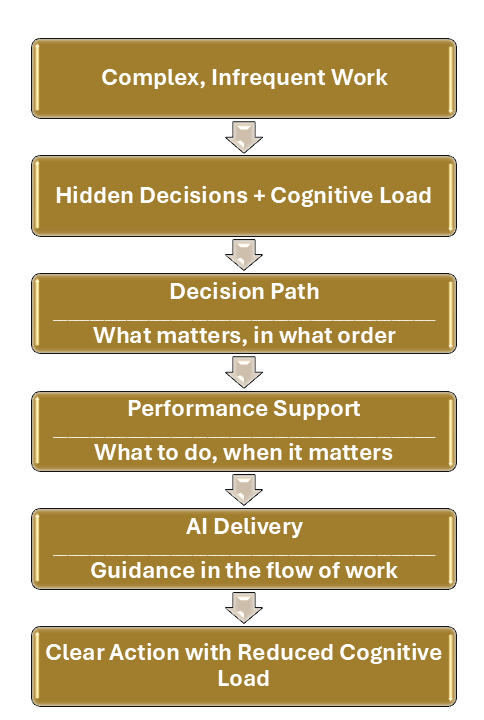
Ask About a Clarifying Pilot ProjectConsider high-value work that happens infrequently but carries real consequences, such as evaluating important opportunities, troubleshooting complex systems, or responding to critical situations. These tasks are often handled differently each time, relying on memory, judgment, and time-consuming review. Our approach starts by turning that work into a clear decision path: defining the key questions, criteria, and actions that matter.
Performance support then directs and informs those decisions and actions at the moment of need, reducing cognitive load and inconsistency. Once that structure exists, AI can guide the workflow, surface relevant information, and support correct action without increasing mental strain. The result is not speed for its own sake, but clearer decisions and more reliable performance when it matters most.

Jerry Marino designs decision and performance support for complex, high-value work where mistakes matter and experience alone is not enough.
Throughout his career, he has been trusted to work on novel systems and high-risk environments where solutions did not yet exist. His focus has consistently been on making complex problems understandable, structuring judgment-heavy work, and reducing the cognitive load placed on professionals performing infrequent but critical tasks.
He brings over two decades of experience designing performance and decision-support systems for complex technical and operational environments, including U.S. Navy C4I and Information Warfare systems,
His background in performance support and decision support shapes how he works with AI. He uses AI when facing new or unfamiliar situations that benefit from exploration and pattern discovery, and avoids it when expertise, experience, and structured judgment are the better tools. AI is applied only after decision paths and performance expectations are clear.
Jerry works primarily as a system designer, translating complex work into clear decision paths, performance support, and practical artifacts that others can rely on. This work is not for tool shoppers or teams seeking instant automation, but for leaders who want clarity, defensible decisions, and reliable performance when it matters most.
LinkedInHow It Works
A decision-first approach to performance support for complex, high-value work
Most complex work breaks down not because people lack skill, but because too much thinking is required at the moment of action.
Important tasks often happen:
In those conditions, relying on memory, experience, or “figuring it out as you go” creates unnecessary cognitive load. People hesitate, overthink, or default to what feels familiar instead of what is correct.
Our work starts by reducing that burden.
Instead of treating work as a set of tasks, we treat it as a sequence of decisions that drive actions.
Together, we make the implicit explicit:
This creates a clear decision path that replaces guesswork with structure.
For complex, high value, or rarely performed work, practice alone is often not possible and never enough.
We design performance support that:
The goal is not to make people work harder - It is to direct right action or decision when it matters most.
AI is useful once the decisions are clear.
After decision paths and performance support are defined, AI can help:
AI is not the starting point - Clarity is.
Most work starts as a short pilot focused on:
This keeps risk low, learning high, and results grounded in reality.
Solutions
Know who deserves your attention before the first call. Decision Signal™ gives your team structured intelligence reports on each prospect — who to contact, why now, and how to open the conversation — so outreach is targeted, consistent, and grounded in real signals rather than instinct.
For: Business-to-Business (B2B) sales teams, marketing agencies, and business development professionals
Stop getting different results every time your team uses AI. The Custom Prompt Library Workshop gives your team a shared, role-aligned library of prompts built around your actual work — so AI produces consistent, reliable outputs across every person and every task.
For: Teams who want AI to work the same way every time, not differently depending on who's using it
Make confident, defensible AI investment decisions without second-guessing. Decision Frame™ gives executives a structured system for evaluating which AI initiatives to pursue, who owns each decision, and what a clear path to implementation looks like — so your organization moves forward on AI with confidence rather than uncertainty.
For: Executives and leaders responsible for approving and governing AI investments
Case Studies
Context
Structured Expert Prospect Decisions for AI
A solo marketing consultant operated in a fast-moving outbound environment where judgment directly impacted lead quality and growth outcomes.
The Challenge
Replaced Implicit Judgment with Explicit Logic
Prospect evaluation relied on unstructured human reasoning that was difficult to explain, automate, or scale but took 30-34 minutes to qualify each prospect into a “Call Now”, “Call Later”, or “Not a Call Priority."
What Was Done
Decomposed Expertise into Decision Signals
Expert judgment was converted into observable signals, structured lenses, and clear rule-based prioritization logic.
Decision Support Created
Built an AI-Ready Decision Framework
A pre-automation decision system was created to enable rapid prospecting but also support future AI workflows while preserving human control.
Impact
Improved Speed, Consistency, and Clarity
Why This Matters
Created a Scalable Foundation for Automation
Human reasoning became explicit, testable, and transferable to future AI and delegation models. This engagement became the foundation for the Decision Signal™ service.
Context
Enabled Real-Time Expert Technical Decisions
High-stakes network operations required rapid, accurate troubleshooting across interconnected systems.
The Challenge
Removed Fragmented Knowledge and Inconsistency
Decision logic scattered across documents and individuals slowed resolution and increased risk.
What Was Done
Converted Expert Reasoning into Guided Workflows
Tacit expertise was structured into clear, repeatable decision paths.
Decision Support Created
Built Reusable Decision Support Architecture
A semantic knowledge base-enabled consistent, explainable troubleshooting.
Impact
Increased Speed, Consistency, and Efficiency
Faster resolution, standardized outcomes, and reduced reliance on senior staff.
Why This Matters
Made Decision Logic Explicit and Scalable
Critical reasoning became transferable across the organization.
Context
Focused Outreach Through Structured Decisions
A customer and marketing team serving small to mid-size businesses needed clearer prioritization in AI-related prospect engagement.
The Challenge
Replaced Intuition with Explainable Prioritization
Outreach relied on inconsistent judgment, stalled initiatives, and unclear value from AI tools.
What Was Done
Converted Readiness Signals into Scoring Logic
Qualitative inputs were structured into an AI readiness questionnaire and decision scoring model.
Decision Support Created
Implemented a Dual-Priority Decision Framework
Prospect readiness and internal calling priority were separated into clear action bands.
Impact
Improved Focus, Alignment, and Execution Speed
Why This Matters
Turned AI Interest into Actionable Decisions
Prospect readiness became explicit, defensible, and reusable across outreach efforts. Prospects were categorized for AI readiness and sales messages were targeted at the customer’s AI development state.
Contact Us and Start a Conversation